
Brown Fat Organoids Development and Crosstalk
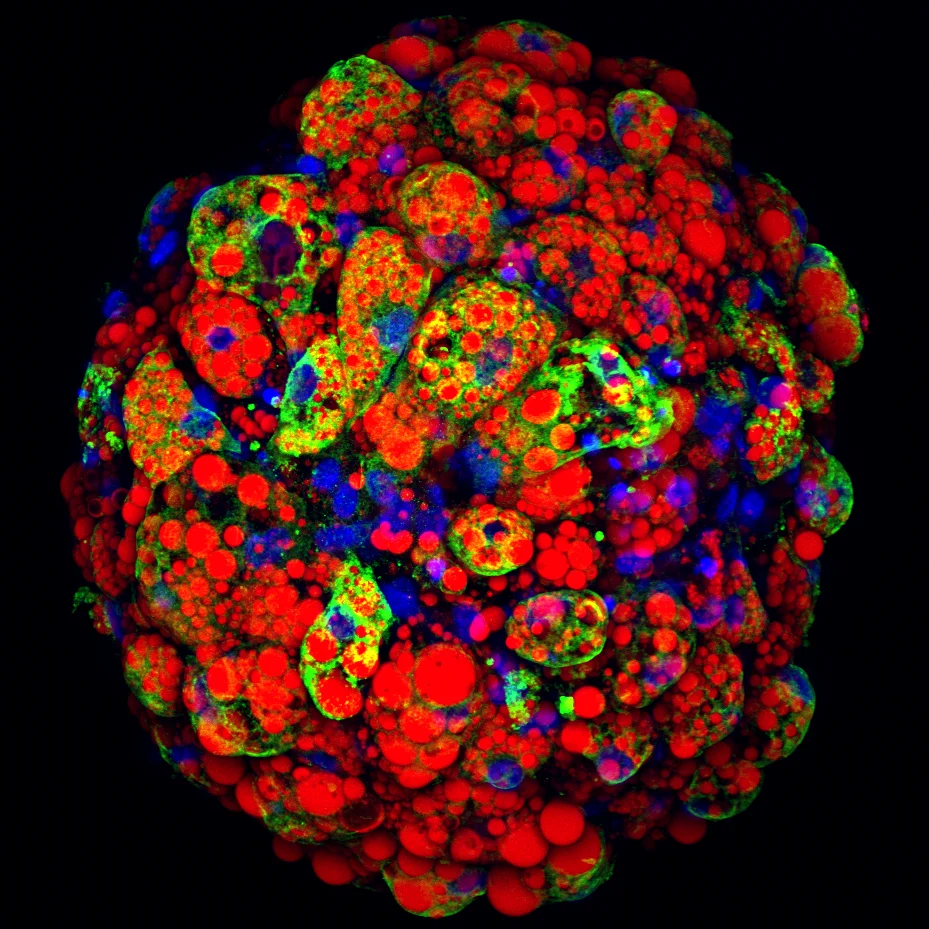
hiPSC-BAO with UCP1 in green, Oil Red O in red and DAPI in blue
© Xi Yao
Three-dimensional (3D) cell culture models have emerged as a powerful approach for mimicking tissue architecture and studying the microenvironment of different organs. Traditional two-dimensional (2D) cell culture systems are valuable for investigating cell-autonomous functions of defined cell types but face significant limitations in recapitulating cell–cell interactions, cellular niches, and the complex microenvironments present in tissues. This is also true for thermogenic adipocytes cultured in 2D.
In this project, we developed murine and human brown adipose tissue 3D/organoid model systems using mouse brown fat stromal vascular fractions (SVFs) and human induced pluripotent stem cells (hiPSCs), respectively. Specifically, we aimed to investigate: (1) how cell-intrinsic remodeling in 3D culture influences brown fat development, and (2) how cell–cell interactions, including vascularization, enhance de novo thermogenic adipogenesis in hiPSC-derived brown fat organoids.
The results of this project will not only identify the molecular mechanisms underlying enhanced thermogenic adipocyte development in organoid culture but also provide novel insights into human brown fat biology.
Project Leader

Prof. Dr. med. Alexander Pfeifer
Institut für Pharmakologie & Toxikologie, Universitätsklinikum Bonn, Universität Bonn
Venusberg-Campus 1
53127 Bonn
© Johann Saba

Prof. Dr. rer. nat. Yongguo Li
Institute of Pharmacology and Toxicology, University Hospital, University of Bonn
Venusberg-Campus 1
53127 Bonn
© Li